Vision Machine · Edge intelligence for machines that fly first and walk next
Foundation models
small enough
to fly.
We compress frontier vision-language and vision-language-action models to run inside small drones: no link, no pilot. Drones are the hardest place to run them. Everything we prove in the air moves to the robots that come next.
The next decade of autonomy
is decided on the machine, not in the cloud.
Frontier vision-language models can already reason about a battlefield in paragraphs and infer intent from a single frame. But none of them have ever flown one. They live in datacenters, lean on fat links, and respond on cloud timescales. In contested airspace, none of that survives contact.
Vision Machine is the team bringing that class of model down onto the machine itself. We compress, distill, and re-architect frontier vision-language and vision-language-action models until they perceive, reason, and act on-board, without ever phoning home. That is the gap we exist to close.
We build our own airframe to prove it in the air first, because flight is the hardest place to run these models. What survives there transfers to everything slower and more forgiving. The same stack moves to ground robots next.
On the machine
Models run inside the platform, on embedded compute. No cloud, no datacenter, no round-trip.
Link-independent
Mission proceeds when jammed, spoofed, or out of range. The link is a convenience, not a requirement.
One model family · every embodiment
VM-Eye, VM-Voice, and VM-Act power the VM-02 Sentinel today, and every machine after it.
One airframe, in build now.
The first body we put the models in, where flight is hardest.
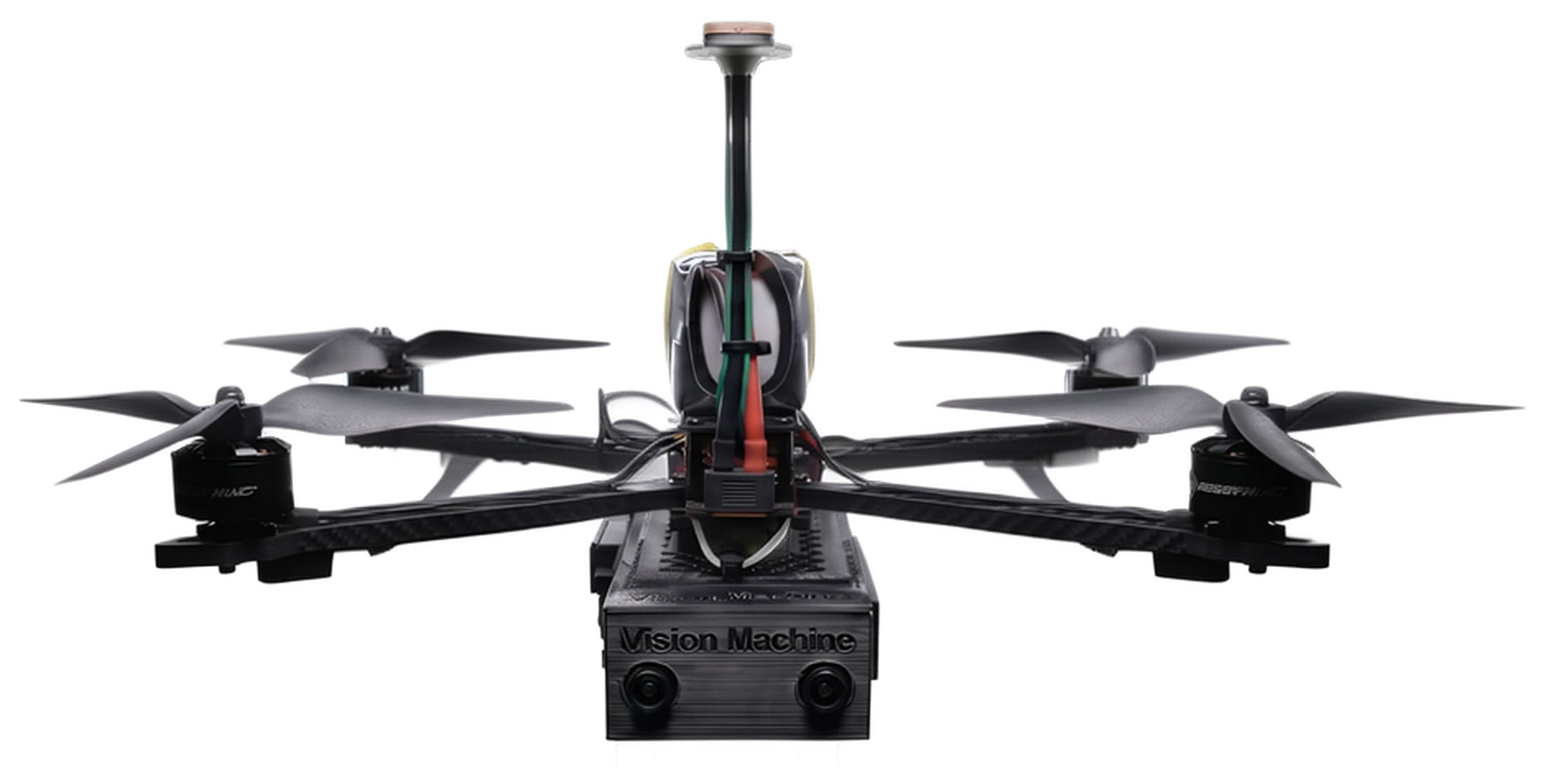
Edge AI core · VM-Eye, VM-Voice and VM-Act run in this module, on the airframe. Nothing phones home.
Carbon airframe · Designed and built in-house. Prototype 01, in build now.
VM-02 · Sentinel · In development
Voice-native reconnaissance. Our first airframe, built in-house to prove the stack in flight.
Brief it by voice, the way you would brief a wingman. It flies its own search, sees and reasons on-board, and reports back in plain language. No link required, no video to scrub. What holds here is what moves to the robots that come next.
Operator Loop · Design Target
“Sweep the treeline east of grid 432-87.”
Minutes later: a spoken and written SITREP. No video to scrub.
Prototype 01 · photographed in build
Three primitives.
Running on one SoC.
Vision-Language Model
Perceive
The drone does not just classify pixels. It captions, grounds, and reasons about what it sees in natural language, running on the airframe at the frame rate of the sensor.
VM-Eye
Intent & Mission Memory
Reason
Whether spoken, typed, or radioed, operator intent is interpreted against on-board perception, rules of engagement, and mission memory. The drone knows what it was asked to do, and why.
VM-Voice
Vision-Language-Action
Act
A small action head closes the loop from perception and intent directly to flight envelopes and gimbal commands. Language in. Motion out. Hard real-time guarantees underneath.
VM-Act
One model family. Air first.
Every machine after.
Foundation models small enough to fly. That is the product. The airframe is how we prove them: trained in-house, under export control, and flown where they are hardest to run. A stack that holds in contested airspace holds in every machine that is slower, heavier, and closer to the ground.
Beyond Our Airframes
The stack is platform-agnostic by design.
Our airframe first, yours next.
VM-Eye
Perception
Sees and reasons about the scene in natural language, on-board, at sensor frame rate.
VM-Voice
Intent
Turns a spoken brief into a mission, and the mission back into a spoken report.
VM-Act
Action
Closes the loop from perception and intent to motion. Language in, flight out.
Embodiment Roadmap
Today
VM-02 Sentinel
Voice-native recon · air · in build
Next
VM-01 Interceptor
Counter-UAS · air · roadmap
After
Ground robots
Same stack · easier physics
Autonomy between operator and objective.
Never between operator and decision to use force.
Rules of engagement, target sets, and engagement envelopes are authored before launch by a human, in writing, cryptographically signed, and enforced by the airframe. Audit trails and post-mission accountability are built into the platform, not bolted on.
Human-authored ROE
Loaded pre-flight · cryptographically signed
Auditable autonomy
Every decision logged, timestamped, replayable
Operator-in-command
Abort, override, recall · link permitting
Request an operational brief.
Available to vetted defense and government customers.
A briefing covers the Sentinel prototype and its current build status, an architecture review of the on-device VLM and VLA stack, and the roadmap: counter-UAS next, ground robots after. What is flying, what is next, and what we are looking for. No theater.
Contact
ahmet@visionmachine.dev
Direct Channel
For an operational brief or technical conversation, write to us directly.
We reply within 24 hours.